
Friday, May 16, 2008
Shortest Tour de France ever
Interesting stories about the records for the briefest performances (to date) in the Tour de France over at CyclingNews.
Labels: history


Friday, July 06, 2007
The race to be last
Interesting quote today in The Independent, though (unfortunately) I think it's no longer accurate in today's Tour:
"LANTERNE MEANS LAST"
"If you can't win the Tour, then the next best thing is to come last. At least that's the philosophy among the also-rans of the peloton, for whom the position of lanterne rouge (red lamp) has become a highly sought-after means of publicity. Initially, any rider who came in last overall after the second stage was kicked out of the race, but in the 1950s the idea of acknowledging riders who struggled honourably to complete the Tour without abandoning or finishing outside the time limit gained in popularity. The race to be last can often eclipse the battle for the yellow jersey, with riders in the frame vying with each other to see who could go slowest without being expelled for exceeding the time limit."
"LANTERNE MEANS LAST"
"If you can't win the Tour, then the next best thing is to come last. At least that's the philosophy among the also-rans of the peloton, for whom the position of lanterne rouge (red lamp) has become a highly sought-after means of publicity. Initially, any rider who came in last overall after the second stage was kicked out of the race, but in the 1950s the idea of acknowledging riders who struggled honourably to complete the Tour without abandoning or finishing outside the time limit gained in popularity. The race to be last can often eclipse the battle for the yellow jersey, with riders in the frame vying with each other to see who could go slowest without being expelled for exceeding the time limit."
Labels: history
Monday, July 11, 2005
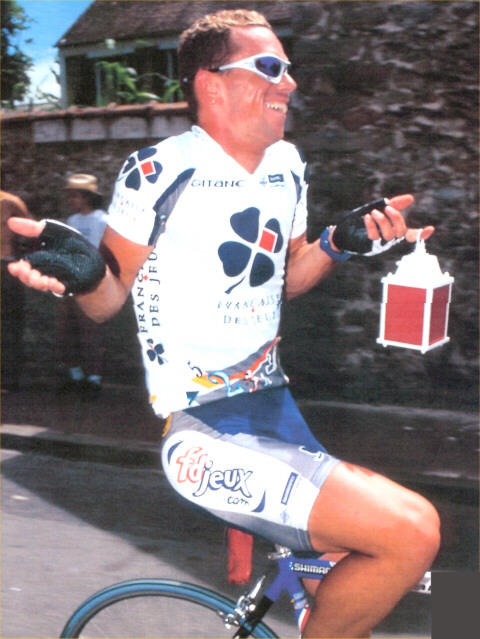
Jimmy Casper, two-time Lanterne Rouge
Here's a wonderful historical photo of Jimmy Casper from 2001, his first time as Tour de France Lanterne Rouge. He repeated in 2004.

The story of Jimmy Casper becoming the Lanterne Rouge while riding for Cofidis in the 2004 Tour de France is here.
The story of Jimmy Casper becoming the Lanterne Rouge while riding for Cofidis in the 2004 Tour de France is here.
Labels: 2001, 2004, Casper, history
Tuesday, July 05, 2005
Lanterne Rouge 2002
This story by Rupert Guinness clearly describes the stress experienced by Christophe Oriol while he held the title in the 2002 Tour.
Lanterne Rouge 2003
From VeloNews in 2003, by Rupert Guinness:
"It wasn't only in the top overall placings of the Tour de France that important changes came about in Saturday's first Pyrenean stage. If you cast your finger down to the end of the right column of the second page of the results sheet - or dragged your cursor to the last place - you'd notice a change that will have gone largely unnoticed.
For the first time since stage 9, Belgian rider Hans De Clercq (Lotto-Domo) is no longer the Tour's lanterne rouge - officially, the last placed rider on overall standings.
De Clercq will most probably have taken his move up from last place to 161st at 2 hours 59 minutes and 23 seconds from 162 survivors as a moral victory. Despite what mythology Tour history placed in being the lanterne rouge, De Clercq was openly dismissive of playing out the role as last placed rider.
"When I was riding in the Alps I felt ashamed every day," he said before passing Italian Raffaele Ferrara (Alessio) who is at 3 hours 4 minutes and 8 seconds to Armstrong.
There is still a long way to go before De Clercq can feel confident in reaching Paris, let alone getting there at least one place up the ladder from last position overall. Being so close, De Clercq realizes too that his destiny is not only his to determine. One bad day for Ferrara - via an elimination or abandon - would put him back into last place.
Come to think of it, so could any desperate measures by Ferrara to remain in the race should he be feeling poorly and take excessive pushes or tows in the climbs.
It is done, as the daily "Decision du College des Commissaires" sheet proves. Today, 10 riders were fined or handed time penalties for such illegalities. Only Friday, Euskaltel teammates David Etxebarria and Unai Etxebarria (not related) were handed so many time penalties, their adjusted times for the time trial stage eliminated them from the Tour!
There is every reason to expect more failure to starts, abandons or eliminations in the next few days. With three Pyrenean stages to go, riders will be stretched to their limits, especially in the searing heat wave that has baked France this summer. While 38 riders have pulled out from the Tour, it is worth remembering that in the Alps alone the race lost 33 of them!
The Pyrénées, from the first of four days of racing there, have so far claimed three riders. Italian Pietro Caucchioli (Alessio) did not start today; while fellow Italian Danilo Di Luca (Saeco) and German Torsten Schmidt (Gerolsteiner) both abandoned during the stage.
No, De Clercq's job and mission is not yet over. Far from it. But given his sense of "shame" for placing last and his will to finish, you can't help but feel he will triumph.
De Clercq's attitude to the lanterne rouge will be welcomed by Tour organizers who were once upon a time angered by all the publicity that the last man received that it made a mockery of the race.
But they can't rub out history already written about the lanterne rouge, the first being Arsène Millocheau who finished 64 hours and 47 minutes behind winner Maurice Garin in 1903. In time, the lanterne rouge became a star of the Tour. Claiming the title guaranteed lucrative appearance fees at post-Tour criteriums.
Only three riders have twice placed last overall in the Tour. They are Daniel Masson (1922, 1923), Gerhard Schoenebacher (1979, 1980) and Mathieu Hermans (1987, 1989).
It was the Austrian Schoenebacher who unintentionally encouraged the Tour organization to break down the sense of achievement in being the last-placed rider. So annoyed was the then race director Félix Lévitan with Schoenebacher's fight to "win" it - and all the still-existing trappings - he even changed the rule midway in the 1980 Tour.
As Schoenebacher recalls, midway into the race, Lévitan brought in a new rule that declared that the last-placed rider overall each day would be eliminated.
"Félix Lévitan became very mad. I got daily interviews. I was very popular with the crowd and I continued to tell everyone that I liked being last," he said.
"Lévitan said I made mockery of the Tour. But after (placing last) I could start in almost every criterium in Holland for 300 euros each night. It was quite a lot of money for me."
Schoenebacher was quick to react when Lévitan changed the rule in 1980. "I managed to stay just in second last place every day (until the last)," he said.
But then, not every lanterne rouge contender has agreed with Schoenebacher in the past. Australian Don Allan who rode the 1974 and 1975 Tours was dead against it, even though he played along with the attention at the time he was last, saying things like: "You have to have a first and last rider. I'll never be the first, so I might as well be the last."
Later, upon reflection, Allan poured water on his enthusiasm, saying: "Everyone said: ‘It's great you'll get a lot of publicity for it.' The team said: "It's great, you'll get money." But I hated it. I didn't enter races to finish last."
Neither did Hans De Clercq."
"It wasn't only in the top overall placings of the Tour de France that important changes came about in Saturday's first Pyrenean stage. If you cast your finger down to the end of the right column of the second page of the results sheet - or dragged your cursor to the last place - you'd notice a change that will have gone largely unnoticed.
For the first time since stage 9, Belgian rider Hans De Clercq (Lotto-Domo) is no longer the Tour's lanterne rouge - officially, the last placed rider on overall standings.
De Clercq will most probably have taken his move up from last place to 161st at 2 hours 59 minutes and 23 seconds from 162 survivors as a moral victory. Despite what mythology Tour history placed in being the lanterne rouge, De Clercq was openly dismissive of playing out the role as last placed rider.
"When I was riding in the Alps I felt ashamed every day," he said before passing Italian Raffaele Ferrara (Alessio) who is at 3 hours 4 minutes and 8 seconds to Armstrong.
There is still a long way to go before De Clercq can feel confident in reaching Paris, let alone getting there at least one place up the ladder from last position overall. Being so close, De Clercq realizes too that his destiny is not only his to determine. One bad day for Ferrara - via an elimination or abandon - would put him back into last place.
Come to think of it, so could any desperate measures by Ferrara to remain in the race should he be feeling poorly and take excessive pushes or tows in the climbs.
It is done, as the daily "Decision du College des Commissaires" sheet proves. Today, 10 riders were fined or handed time penalties for such illegalities. Only Friday, Euskaltel teammates David Etxebarria and Unai Etxebarria (not related) were handed so many time penalties, their adjusted times for the time trial stage eliminated them from the Tour!
There is every reason to expect more failure to starts, abandons or eliminations in the next few days. With three Pyrenean stages to go, riders will be stretched to their limits, especially in the searing heat wave that has baked France this summer. While 38 riders have pulled out from the Tour, it is worth remembering that in the Alps alone the race lost 33 of them!
The Pyrénées, from the first of four days of racing there, have so far claimed three riders. Italian Pietro Caucchioli (Alessio) did not start today; while fellow Italian Danilo Di Luca (Saeco) and German Torsten Schmidt (Gerolsteiner) both abandoned during the stage.
No, De Clercq's job and mission is not yet over. Far from it. But given his sense of "shame" for placing last and his will to finish, you can't help but feel he will triumph.
De Clercq's attitude to the lanterne rouge will be welcomed by Tour organizers who were once upon a time angered by all the publicity that the last man received that it made a mockery of the race.
But they can't rub out history already written about the lanterne rouge, the first being Arsène Millocheau who finished 64 hours and 47 minutes behind winner Maurice Garin in 1903. In time, the lanterne rouge became a star of the Tour. Claiming the title guaranteed lucrative appearance fees at post-Tour criteriums.
Only three riders have twice placed last overall in the Tour. They are Daniel Masson (1922, 1923), Gerhard Schoenebacher (1979, 1980) and Mathieu Hermans (1987, 1989).
It was the Austrian Schoenebacher who unintentionally encouraged the Tour organization to break down the sense of achievement in being the last-placed rider. So annoyed was the then race director Félix Lévitan with Schoenebacher's fight to "win" it - and all the still-existing trappings - he even changed the rule midway in the 1980 Tour.
As Schoenebacher recalls, midway into the race, Lévitan brought in a new rule that declared that the last-placed rider overall each day would be eliminated.
"Félix Lévitan became very mad. I got daily interviews. I was very popular with the crowd and I continued to tell everyone that I liked being last," he said.
"Lévitan said I made mockery of the Tour. But after (placing last) I could start in almost every criterium in Holland for 300 euros each night. It was quite a lot of money for me."
Schoenebacher was quick to react when Lévitan changed the rule in 1980. "I managed to stay just in second last place every day (until the last)," he said.
But then, not every lanterne rouge contender has agreed with Schoenebacher in the past. Australian Don Allan who rode the 1974 and 1975 Tours was dead against it, even though he played along with the attention at the time he was last, saying things like: "You have to have a first and last rider. I'll never be the first, so I might as well be the last."
Later, upon reflection, Allan poured water on his enthusiasm, saying: "Everyone said: ‘It's great you'll get a lot of publicity for it.' The team said: "It's great, you'll get money." But I hated it. I didn't enter races to finish last."
Neither did Hans De Clercq."
Labels: 2003, Allan, Caucchioli, De Clercq, Di Luca, Etxebarria, Ferrara, Garin, Hermans, history, Levitan, Masson, Millocheau, Schmidt, Schoenebacher
Lanterne Rouge 1999 & 2000
Blasts from the past:
Here's a piece on the battle for the Lanterne Rouge in 2000. (Thanks for the link, Bob!)
And from the 1999 Tour, by Andrew Hood:
"The last-place in the Tour de France isn't a bad place to be. At least you're still in the race, something more than 20 racers can't say midway through the 1999 Tour.
Tour organizers eliminated the "lanterne rouge" prize a few years ago because riders were purposely going slow to finish last in the stage. This year's red lantern is Australia's Jay Sweet, sprinter on the Big Mat team.
The 23-year-old from Adelaide is making his Tour debut and sits in last place in 2 hours, 4 minutes, 17 seconds in arrears. Sweet finished outside the time limit in Tuesday's stage to Sestrieres and struggled up L'Alpe d'Huez after race officials let him start the stage.
"It's been my life's dream to make it through the Tour de France, that's why I keep fighting. I hope to recover a little bit in these next few stages before the Pyrenees," Sweet told ESPN.com before Thursday's stage.
In Tuesday's stage Sweet was absolutely last in the climb to Sestrieres. After Lance Armstrong won the stage, kissed the podium girls and gave a press conference, Sweet was still suffering. It started to rain, then pour. The grupetto, the last group of riders, crossed the line 44 minutes after Armstrong's winning time, and Sweet was still suffering. He finally crossed the line alone, 56:59 later.
"It was raining so hard. There were no spectators at the finish line. Everyone was standing around waiting for me to finish so they could start taking down the barriers. There was no way I was going to stop," Sweet said.
He's still in the race, even it's in last place."
Here's a piece on the battle for the Lanterne Rouge in 2000. (Thanks for the link, Bob!)
And from the 1999 Tour, by Andrew Hood:
"The last-place in the Tour de France isn't a bad place to be. At least you're still in the race, something more than 20 racers can't say midway through the 1999 Tour.
Tour organizers eliminated the "lanterne rouge" prize a few years ago because riders were purposely going slow to finish last in the stage. This year's red lantern is Australia's Jay Sweet, sprinter on the Big Mat team.
The 23-year-old from Adelaide is making his Tour debut and sits in last place in 2 hours, 4 minutes, 17 seconds in arrears. Sweet finished outside the time limit in Tuesday's stage to Sestrieres and struggled up L'Alpe d'Huez after race officials let him start the stage.
"It's been my life's dream to make it through the Tour de France, that's why I keep fighting. I hope to recover a little bit in these next few stages before the Pyrenees," Sweet told ESPN.com before Thursday's stage.
In Tuesday's stage Sweet was absolutely last in the climb to Sestrieres. After Lance Armstrong won the stage, kissed the podium girls and gave a press conference, Sweet was still suffering. It started to rain, then pour. The grupetto, the last group of riders, crossed the line 44 minutes after Armstrong's winning time, and Sweet was still suffering. He finally crossed the line alone, 56:59 later.
"It was raining so hard. There were no spectators at the finish line. Everyone was standing around waiting for me to finish so they could start taking down the barriers. There was no way I was going to stop," Sweet said.
He's still in the race, even it's in last place."
Labels: 1999, 2000, Armstrong, history, Sweet

